• That, friends will come and friends will go and you should cherish the ones that remain with you at the end of the day.
• That love, like happiness, can never be pursued; you need to wait for it patiently to come and enter your life.
• That, all the studying and fretting over marks in school and college will not help you later at the workplace; that requires a completely different set of skills.
• That, no matter how much you fight with your younger brother during your teens and early adulthood, he is going to be one of your closest pals later in life.
• That, getting married early is not a kind of bondage, but a beautiful opportunity to grow along and explore life with another person.
• That, though you will get irritated with kids at the time of their growing up, the joy they bring you is boundless.
• That, speaking the truth is over-rated because not everyone can handle honesty.
• That, you are going to regret, later in life, the time you never spent with your parents which you could have.
• That, worrying about what other people are thinking about you is going to get you nowhere because other people are really not thinking about you; they are thinking about what other people are thinking about them.
• That, you should consider yourself lucky if you have a single, considerate boss in your entire career – someone you can go up to and talk whatever it is that is bothering you, someone who can act like a mentor.
• That, you can run away from the things you really want but they don’t run away from you; they will keep pestering you till you give in to them.
• That, being frank and outspoken is a quality which many do not always appreciate.
• That, as you age, you mellow down and change into a completely different person; a person who forgets and forgives things which they wouldn’t when they were younger.
• That, the interests you develop when you are in school, such as reading, travelling and music, stay with you for life.
• That, being a socially active person who speaks to almost anyone and everyone is any day better than being a quiet, introvert who might be mistaken for being snobbish.
• That, counting your blessings daily is a great way to develop gratitude and attract more of the good things into your life.
• That, we should be grateful God does not give us all that we ask for.
• That, facing your fears is a good way of banishing them; the release it provides is unimaginable.
• That, there are no limits for what you can do, except the ones you set yourself.
• That, you need not always be nice and friendly with everybody; some people just do not deserve the same.
This post is a part of Write Over the Weekend, an initiative for Indian Bloggers by BlogAdda
Sunday, September 30, 2012


Friday, September 21, 2012
Book Review: The Krishna Key by Ashwin Sanghi
I have read Chanakya’s Chant by Ashwin Sanghi and loved the way the inter-play between the past and the present was narrated. In The Krishna Key, the author again uses the same style beautifully and puts in front of us a brilliant masterpiece.
The author’s style of writing is free-flowing and the narrative effortlessly moves back and forth. The book is a definite page-turner and keeps you engrossed until the very last page because of its numerous twists and turns. Without revealing too much about the plot, the way the author moves across different geographic regions and weaves them into the story is wonderful.
One gets a sense of reading Dan Brown because of the fact that Ashwin has also written about mythology and connected it to events in the present scenario. However, the interesting fact with this book, unlike Chanakya’s Chant, is that this book also has science, history, geography, linguistics and geometry to accompany mythology. The author has done immense research in each of the different subjects listed above and it shows in the way these are built into the story without appearing out of place. Also, the author uses Sanskrit shlokas to emphasize certain points and the book has some wonderful pictures/diagrams/maps which assist in taking the story forward as also providing us a visual explanation.
Ashwin has developed a good understanding of the topic at hand and has explained it lucidly in the book. While reading the book, I kept making a list of topics that I would want to read about further; that is the kind of interest the book is able to generate.
The characters of the protagonist and all the others are beautifully etched and it is easy to picture them while reading the book. The author uses very vivid words to describe each of his characters, including their education, family background, current occupations, etc. so that it is easy to get into their mind and understand why they are doing what they are doing. Some of the locations in the story are described so wonderfully that one feels like dropping everything and just visiting those places.
The only negative for me in the book was that there are so many characters and sub-plots that one gets confused and often needs to go back again to connect the dots. However, that is a minor flaw, in an otherwise gem of a book. I am sure that as a result of the book, a lot of us would get to know a lot about Lord Krishna. We only know that he was quite playful and mischievous and, of course, the fact that he was a mentor to Arjuna during the war. However, we barely know anything about his family or what kind of a ruler he was. This book would change all that. For me, personally, since my family deity is Devaki-Krishna, the book made for a compelling read.
The book would also make us appreciate the fact that we only need to believe in something to turn it into reality. Ashwin puts it beautifully when he says, “By simply believing that their lives could be transformed, they succeeded in converting their thoughts to reality.”
I would definitely recommend this book to anyone who would enjoy a fast-paced thriller with the added attraction of getting under the skin of a mythological figure while, at the same time, questioning some of our beliefs pertaining to history.
This review is a part of the Book Reviews Program at BlogAdda.com. Participate now to get free books!
 The Krishna Key by Ashwin Sanghi
This review is a part of the Book Reviews Program at BlogAdda.com. Participate now to get free books!
The Krishna Key by Ashwin SanghiSaturday, August 11, 2012
Delhi through my eyes
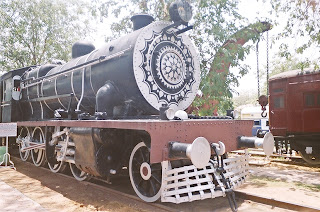
I recently had a chance to visit the National Capital. Some of the sights I captured on this journey are:




Delhi's most famous tourist spot - the Qutb Minar

The colourful jholas at Delhi Haat

The ever serene Lotus Temple

National Rail Museum

National Science Museum

The imposing Rashtrapati Bhavan
Thursday, August 09, 2012
From Aankhen to Zanjeer - and everything in between!
I have been an avid and a long-time reader of Diptakirti Chaudhuri's blog. Though I do not share his love for food or sports, I do love reading about his obsession with Bollywood. One has only to go through some random entries on his blog to realize it. Thus, it comes as no surprise that the man actually chose to write a book on it!
The first thing that strikes you about Kitnay Aadmi Thay (KAT) is that it has no contents section in the front and no index in the back. It is a completely random book that the reader is supposed to read as s/he wishes - jumping from one list to the other. The book is a collection of several random lists which make for interesting reading. To whet your appetite, some of the lists include: Song Names which Became Movies, Top Brother-Sister Pairs, Roles which went beyond the Movies, Movies which Inspired Other Movies, etc. I am only half-way through the book but believe me when I say that the book is unputdownable. I was reading it at breakfast this morning and almost got late for work on a Monday morning!!!
Dipta's obsession with certain Bollywood celebrities for e.g. Big B, RDB, Madhuri, etc. is quite apparent throughout the book. Sholay, which the author mentions as The Greatest Movie Ever Made, also appears in quite a few lists. As does a personal favourite of mine - Jaane Bhi Do Yaaron!!!
The book is peppered with a healthy dose of humour in Dipta's inimitable writing style. Sample this: Speaking about Kal Ho Naa Ho, the author says that when your doctor Sonali Bendre leaves you to marry Sanjay Kapoor, you should commit suicide if you do not die of an illness :)
I am sure the book will be a great gift for those who have impromptu quizzes on Bollywood or for those who want to know every minute detail about the movies (like me - what book was Sharmila reading in Mere Sapnon Ki Rani? what was Amol Palekar's qualification in Golmaal? why did the kid Anjali's parents name her Anjali in Kuch Kuch Hota Hain? :)) I have bought 5 copies of the book to gift my family and friends. I have loved the book so far and I hope they do too!
The only thing left for Dipta to do now is come out with a second book listing all the things which he mentions in KAT would require a separate book :)
This review has been published on www.homeshop18.com.
 Kitnay Aadmi Thay : Completely Useless Bollywood Trivia by Diptakirti Chaudhuri
Tuesday, August 07, 2012
Love Marriage Or Arranged Marriage
The debate between Love Marriage and Arranged Marriage is an old one and is in existence since time immemorial. In the olden days, even royalty and politicians used to go in for an arranged marriage to ensure their status and wealth in society. Arranged marriage is a common phenomenon in countries like India. However, the Western world frowns upon such a practice and openly advocates love marriage.
This blog entry (being submitted as an entry for the Indiblogger contest www.facebook.com/LoveYaArrange) shall try and examine the pros and cons of both the approaches.
Arranged marriage, as a concept, is based on the premise that your elders know what is best for you and can take a better decision than you. Also, in olden times, when marriages used to happen at a young age, the groom and the bride were not mature enough to take such an important decision of choosing their life partner. Additionally, since in the earlier ages, a lot of women were not going in for higher education or forming a large part of the workforce, it was difficult to fall in love and ensure its culmination into marriage (which is largely the scenario these days). Also, especially in India, since religions/castes/sects/sub-sects/languages, etc. plays such a pivotal role in our day-to-day living, fixing a marriage with a person from the same religion/caste, etc. was being practised.
The main advantage (if you can call it that) in an arranged marriage is that you can explore a completely new relationship with your spouse as you go along on the journey of life. Everything is an adventure, everything seems special and new. Also, since your parents have fixed the relation, you have their unstinted support when it comes to your family life. Adjustment issues might be minimized based on the religion/caste/language criteria. Also, you are more willing to adjust and ensure not to hurt your partner since both of you are learning each other’s habits and way of living on almost a daily basis.
The argument in favour of arranged marriage can also be made based on the fact that so many of them are working successfully since time immemorial. And the husband and wife have truly learned to love each other after marriage.
In recent times, due to globalization, increased presence of women at the workforce/in higher education and the youth being more aware, love marriages are gaining prominence, even in a traditional society like India. Firstly, the young are marrying at a relatively later age, after having established themselves financially. Thus, they believe they are mature enough to select a life partner themselves and not depend on their family.
Secondly, there are enough opportunities available to today’s youth to mingle with each other, fall in love and eventually get married. Love marriages usually happen during Engineering/MBA/CA days or when two people work together on a prolonged basis. Being with each other almost day in and day out exposes you to the person’s true nature – their likes/dislikes, their strengths/weaknesses, their temper, their thinking, etc. Based on the same, a judgement can be made about whether one is compatible with the other.
A break-down of religious/casteist sentiments has led to a surge in inter-caste/inter-religious marriages in recent times. Today parents are also more open-minded in accepting such alliances compared to previous times.
One of the primary negatives associated with an arranged marriage is the inability to adjust. As there is not much time for the couple to interact before marriage, in case one of them has very shocking qualities/habits, it may become difficult for the other to adjust. Also, it is generally believed that both the groom and the bride are on their best behaviour before marriage and the real nature comes out into the open only after marriage.
It is also usually observed (though not necessarily) that the practise of arranged marriage is associated with dowry. The boy’s parents demand a lot of things pre-marriage and the girl’s family, in a bid to placate them, provide the same. This, however, continues throughout the lifetime which may put the girl’s family under a heavy burden.
The negatives around love marriage usually center around the fact that either the boy or the girl “change” their habits after marriage. Since both have spent a reasonable amount of time with each other before getting married, they believe they know each other in and out. But, as they say, a husband is different from a boyfriend. This may lead to disputes between the couple. The willingness to adjust is minimal for the same reasons stated above.
Sometimes, in case either of the families does not support the marriage for whatever reason, the couple may find it difficult in a trouble situation. Also, though society is slowly becoming open-minded, some marriages may still be frowned upon or openly discouraged (the recent incidents of the khap panchayats indulging in honour killing or certain families ensuring the boy/girl are murdered are extreme consequences of a love marriage).
To sum up, each of the approaches has its own merits and demerits. To say that one approach works and the other does not would be incorrect. At the end of the day, it is for an individual to decide whether s/he wants to go in for an arranged marriage or a love marriage. Jane Austen's quote gives a fitting gist: "Happiness in marriage is entirely a matter of chance. If the dispositions of the parties are ever so well known to each other or ever so similar beforehand, it does not advance their felicity in the least. They always continue to grow sufficiently unlike afterwards to have their share of vexation; and it is better to know as little as possible of the defects of the person with whom you are to pass your life."
This blog entry (being submitted as an entry for the Indiblogger contest www.facebook.com/LoveYaArrange) shall try and examine the pros and cons of both the approaches.
Arranged marriage, as a concept, is based on the premise that your elders know what is best for you and can take a better decision than you. Also, in olden times, when marriages used to happen at a young age, the groom and the bride were not mature enough to take such an important decision of choosing their life partner. Additionally, since in the earlier ages, a lot of women were not going in for higher education or forming a large part of the workforce, it was difficult to fall in love and ensure its culmination into marriage (which is largely the scenario these days). Also, especially in India, since religions/castes/sects/sub-sects/languages, etc. plays such a pivotal role in our day-to-day living, fixing a marriage with a person from the same religion/caste, etc. was being practised.
The main advantage (if you can call it that) in an arranged marriage is that you can explore a completely new relationship with your spouse as you go along on the journey of life. Everything is an adventure, everything seems special and new. Also, since your parents have fixed the relation, you have their unstinted support when it comes to your family life. Adjustment issues might be minimized based on the religion/caste/language criteria. Also, you are more willing to adjust and ensure not to hurt your partner since both of you are learning each other’s habits and way of living on almost a daily basis.
The argument in favour of arranged marriage can also be made based on the fact that so many of them are working successfully since time immemorial. And the husband and wife have truly learned to love each other after marriage.
In recent times, due to globalization, increased presence of women at the workforce/in higher education and the youth being more aware, love marriages are gaining prominence, even in a traditional society like India. Firstly, the young are marrying at a relatively later age, after having established themselves financially. Thus, they believe they are mature enough to select a life partner themselves and not depend on their family.
Secondly, there are enough opportunities available to today’s youth to mingle with each other, fall in love and eventually get married. Love marriages usually happen during Engineering/MBA/CA days or when two people work together on a prolonged basis. Being with each other almost day in and day out exposes you to the person’s true nature – their likes/dislikes, their strengths/weaknesses, their temper, their thinking, etc. Based on the same, a judgement can be made about whether one is compatible with the other.
A break-down of religious/casteist sentiments has led to a surge in inter-caste/inter-religious marriages in recent times. Today parents are also more open-minded in accepting such alliances compared to previous times.
One of the primary negatives associated with an arranged marriage is the inability to adjust. As there is not much time for the couple to interact before marriage, in case one of them has very shocking qualities/habits, it may become difficult for the other to adjust. Also, it is generally believed that both the groom and the bride are on their best behaviour before marriage and the real nature comes out into the open only after marriage.
It is also usually observed (though not necessarily) that the practise of arranged marriage is associated with dowry. The boy’s parents demand a lot of things pre-marriage and the girl’s family, in a bid to placate them, provide the same. This, however, continues throughout the lifetime which may put the girl’s family under a heavy burden.
The negatives around love marriage usually center around the fact that either the boy or the girl “change” their habits after marriage. Since both have spent a reasonable amount of time with each other before getting married, they believe they know each other in and out. But, as they say, a husband is different from a boyfriend. This may lead to disputes between the couple. The willingness to adjust is minimal for the same reasons stated above.
Sometimes, in case either of the families does not support the marriage for whatever reason, the couple may find it difficult in a trouble situation. Also, though society is slowly becoming open-minded, some marriages may still be frowned upon or openly discouraged (the recent incidents of the khap panchayats indulging in honour killing or certain families ensuring the boy/girl are murdered are extreme consequences of a love marriage).
To sum up, each of the approaches has its own merits and demerits. To say that one approach works and the other does not would be incorrect. At the end of the day, it is for an individual to decide whether s/he wants to go in for an arranged marriage or a love marriage. Jane Austen's quote gives a fitting gist: "Happiness in marriage is entirely a matter of chance. If the dispositions of the parties are ever so well known to each other or ever so similar beforehand, it does not advance their felicity in the least. They always continue to grow sufficiently unlike afterwards to have their share of vexation; and it is better to know as little as possible of the defects of the person with whom you are to pass your life."
Saturday, February 18, 2012
Book Review: Tea for Two and A Piece of Cake
This is one of my first book reviews. The author is a well-known blogger - http://justamotheroftwo.blogspot.in - someone whom I have been following for such a long time. Tea for Two and A Piece of Cake is her third book, her first two have been national best-sellers.
The book starts off in the present and keeps alternating between the present and the past. It is a love story between three people but there are several more whose lives are inter-twined with these three. Preeti's writing style is free-flowing and lucid and she manages to keep us engrossed through the entire length of the book (I finished it in one sitting :))
The book explores various relationships as the story moves forward and you tend to want to know what is happening with the protagonist's life; it definitely is a page-turner. You also identify with the ups and downs that she is going through as she questions the decisions she has made at each stage of her life.
The part I liked the most is that Preeti has named all the chapters after a lot of famous songs; that is most certainly unique :) I wish her all the luck and hope this book goes on to become a best-seller as well!
The book starts off in the present and keeps alternating between the present and the past. It is a love story between three people but there are several more whose lives are inter-twined with these three. Preeti's writing style is free-flowing and lucid and she manages to keep us engrossed through the entire length of the book (I finished it in one sitting :))
The book explores various relationships as the story moves forward and you tend to want to know what is happening with the protagonist's life; it definitely is a page-turner. You also identify with the ups and downs that she is going through as she questions the decisions she has made at each stage of her life.
The part I liked the most is that Preeti has named all the chapters after a lot of famous songs; that is most certainly unique :) I wish her all the luck and hope this book goes on to become a best-seller as well!
Tuesday, March 15, 2011
Movie-books-music tag
Rules:
1.The tag has three parts..Movies,Music, Books/ Authors.
2.Write a movie, book and author with each alphabet of your first name. The book, movie or song should be one that you really liked. If you say why it matters to you, it would be great! We will all discover new songs, movies and books this way.
3.Tag as many people as there are letters in your name.
4.The tag originated here http://justamotheroftwo.blogspot.com/2011/03/fun-movie-books-music-tag.html
5.Copy paste these rules :)
Movies
Parineeta: Saif, Vidya & Sanjay - the trio rocked Box Office...and, of course, Kaisi Paheli Yeh Zindagani
Andaz Apna Apna: See it to believe it! You will never get bored seeing the movie :)
Love: Salman Khan in a much more sober version; Revati at her usual best...
Lakshya: Hrithik, Ladakh, Preity, awesome songs, wonderful script - what's not to like?
Anand: Babu Moshai! Hum sab kattputli hain :) Rajesh/Amitabh's pair worked wonders.
Viruddh: Ageing parents fighting for justice for their dead son.
Indecent Proposal: With Robert Redford suggesting a deal, who could refuse? :)
Authors/books
Paulo Coelho: Inspirational stuff..When you want something, the entire universe conspires in helping you to achieve it
Ayn Rand: Who is John Galt? Read Rand to find out!!!
Love in the Time of Cholera: Gabriel Garcia Marquez's masterpiece
Love Story: What do you say about a 25-year-old who died?
A Suitable Boy: Vikram Seth's magnum opus about a mother's search for a son-in-law :)
Vikram Seth: :) adore him...An Equal Music, yet to read The Golden Gate though
It's Not About The Bike: Lance Armstrong on Tour de France; it's hard not to get inspired...
Songs
Pehla Nasha: song of young romance...song of Aamir with Pooja...we have all sung this at least once :)
Abhi Kuch Dinon Se: Mohit Chauhan in Dil Toh Bachcha Hain Ji!!!
Lakdi Ki Kaathi: Masoom...Naseer...Shabana...
Love Is All Around: Wet Wet Wet...I feel it in my fingers :)
Aaj Din Chaddeya: Kaise khuda hain tu...Saif pleading with God in Love Aaj Kal
Vaada Rahan Sanam: Akshay & Ayesha in Khiladi
In Dino Dil Mera: Life In A Metro
Movies
Parineeta: Saif, Vidya & Sanjay - the trio rocked Box Office...and, of course, Kaisi Paheli Yeh Zindagani
Andaz Apna Apna: See it to believe it! You will never get bored seeing the movie :)
Love: Salman Khan in a much more sober version; Revati at her usual best...
Lakshya: Hrithik, Ladakh, Preity, awesome songs, wonderful script - what's not to like?
Anand: Babu Moshai! Hum sab kattputli hain :) Rajesh/Amitabh's pair worked wonders.
Viruddh: Ageing parents fighting for justice for their dead son.
Indecent Proposal: With Robert Redford suggesting a deal, who could refuse? :)
Authors/books
Paulo Coelho: Inspirational stuff..When you want something, the entire universe conspires in helping you to achieve it
Ayn Rand: Who is John Galt? Read Rand to find out!!!
Love in the Time of Cholera: Gabriel Garcia Marquez's masterpiece
Love Story: What do you say about a 25-year-old who died?
A Suitable Boy: Vikram Seth's magnum opus about a mother's search for a son-in-law :)
Vikram Seth: :) adore him...An Equal Music, yet to read The Golden Gate though
It's Not About The Bike: Lance Armstrong on Tour de France; it's hard not to get inspired...
Songs
Pehla Nasha: song of young romance...song of Aamir with Pooja...we have all sung this at least once :)
Abhi Kuch Dinon Se: Mohit Chauhan in Dil Toh Bachcha Hain Ji!!!
Lakdi Ki Kaathi: Masoom...Naseer...Shabana...
Love Is All Around: Wet Wet Wet...I feel it in my fingers :)
Aaj Din Chaddeya: Kaise khuda hain tu...Saif pleading with God in Love Aaj Kal
Vaada Rahan Sanam: Akshay & Ayesha in Khiladi
In Dino Dil Mera: Life In A Metro
Subscribe to:
Posts (Atom)