
Listening to Arunachalam Muruganantham narrate his story on how he set about to produce sanitary napkins at a cheaper cost (http://www.youtube.com/watch?v=u1iWhljEbTE) made me realize what a great man he is. He effectively killed two birds with one stone – he found a solution for women to better deal with menstruation at a cheaper cost and also provided them gainful employment in the process. In India, as in some nations across the world, menstruation continues to be a taboo topic; women do not discuss it openly and men blissfully turn a deaf ear to it. While only 5% of the women in India use sanitary napkins, the rest resort to rags, saw dust and even ashes. Needless to say, the latter bring with it a host of health problems.
My thoughts on the ‘Big Issue’ have been presented using each letter of Arunachalam’s name:
Awareness:
Arunachalam came across this idea when he saw his wife gather rags one day. When asked why she did not use sanitary napkins, the wife put forth the cost angle. This led Arunachalam to ponder over the problem faced by hundreds of women which have to deal with this in such a fashion.
Responsiveness:
Once he became aware, Arunachalam did not sit quiet like most men would have. Instead, he decided to go to the root cause of the problem and decide what could be done about it. He knew fully well that he was entering into a taboo territory.
Unusual:
What Arunachalam thought next was quite unusual. He decided to manufacture low-cost sanitary napkins himself. This would ensure that women start using the napkins and eliminate the health problems faced by them.
Need-based:
The solution designed by Arunachalam to the problem was need-based. He would develop a low-cost napkin which women would be willing to use as against the high-cost one which they did not.
Abandoned:
Needless to say, considering Arunachalam was openly discussing a taboo topic, his family and friends abandoned him. He was ostracized from his village for his endeavours. People thought that he has gone mad or spirits have entered his body.
Challenges:
Arunachalam also had to face challenges in the form of volunteers needed to test the product. Women were unwilling to discuss their menstruation problems with a complete stranger. But he did not let these deter him.
Hard-working:
When he realised that he could not find volunteers, he decided to test the product himself using animal blood and a football bladder.
Acceptability:
His efforts finally paid off when he was able to develop a sanitary napkin on a machine he built himself.
Low-cost:
The best part about these napkins was that these were manufactured at less than a third of those sold by MNCs. Also, these were being manufactured at local level by women who gained employment resulting in a win-win situation.
Awards:
Arunachalam’s efforts bore fruit and he received the 2009 Best Innovation Award from the Indian President Smt. Pratibha Patil. Earlier, in 2006, his machine also won the award for the best innovation for the betterment of society from IIT, Chennai.
Meaningful:
Thus designing a solution to an all-pervasive problem led to Arunachalam’s life becoming more meaningful. As he states at the end of his talk, “What do you need to make your life meaningful? You need a problem.”
His story needs to be shared far and wide for many reasons. Firstly, he is an entrepreneur with a difference. He saw an opportunity to innovate in a field as taboo as menstruation. Secondly, when he started, he knew he would be competing against the big MNCs such as P&G and Johnson & Johnson. That, however, did not deter him. Thirdly, even when his wife and his mother left him and he had to leave his village, he did not let go of his passion and continued to put in efforts. Fourthly, he has no qualms about admitting that he is not so well educated nor fluent in English. In fact, he uses his ability to make jokes on himself brilliantly to put across his views.
I have personally experienced the anecdote narrated by Arunachalam: of a chemist wrapping the packet of sanitary napkins in a newspaper. It is indeed sad to think that while India continues to make great progress in almost every other field with women contributing an equal share, a natural thing like menstruation continues to be taboo. I hope the innovation by Arunachalam, in addition to enabling rural and other women to start using sanitary napkins, also encourages discussions on menstruation amongst all sections of society in a healthy fashion.
Franklin Templeton Investments partnered the TEDxGateway Mumbai in December 2012.
Saturday, July 20, 2013


Tuesday, July 16, 2013
Acid Attacks: A Social Crime
I have written about the menace of acid attacks in India on the Stop Street Harassment (SSH) blog. Refer the article here:
http://www.stopstreetharassment.org/2013/07/india-acid-attacks/
I will be writing one article per month (from July to December 2013) about Street Harassment in India as an SSH correspondent.
http://www.stopstreetharassment.org/2013/07/india-acid-attacks/
I will be writing one article per month (from July to December 2013) about Street Harassment in India as an SSH correspondent.
Sunday, July 07, 2013
Book Review: The Homing Pigeons by Sid Bahri
This book is Sid Bahri's first book. He is a hotelier by education, an ex-banker and a senior executive in the outsourcing industry. Sid gave up a plush career in the outsourcing industry to follow his passions.
The book's blurb reads: "In the middle of the catastrophic 2008 recession, Aditya, a jobless, penniless man meets an attractive stranger in a bar. Little does he know that his life will change forever. When Radhika, a young, rich widow, marries off her stepdaughter, little does she know that the freedom she has yearned for is not exactly how she had envisioned it. They say homing pigeons always come back to their mate, no matter where you leave them on the face of this earth. The Homing Pigeons is the story of love between these two unsuspecting characters as it is of lust, greed, separations, prejudices and crumbling spines."
From the blurb itself, the reader knows what the end shall be eventually. However, the way the author reaches it is what forms the crux of the book. The book is written in a very interesting fashion - in a first-person account from the point of view of the two main characters Aditya and Radhika. At some point in the book, their stories intersect and overlap and the author leaves it to the reader to make sense of their individual versions of the events as they unfold.
The author has drawn on his experiences as an ex-banker to describe the job roles in Citibank where both the protagonists work. Also, North India (where the book is set), specifically, New Delhi, Chandigarh and Solan are well detailed in the book - places to visit such as Dilli Haat, to eat such as Indian Coffee House, etc.
Sid has etched both the characters very well through different stages of their lives. The book makes for an easy read and you are drawn into the several problems and issues the characters face. The book touches upon major issues ranging from Indira Gandhi's assassination to the Y2K problem to the 2008 recession which affected both Indians and NRIs alike.
On the flipside, I felt the book was a little too long with situations repeating themselves after a point in time. Also, the tenses kept alternating between the past and the present resulting in some chaos.
I am going with 3/5 for this book - an interesting read which takes you through the frailties of human behaviour and complicated relationships.
This book review is a part of "The Readers Cosmos Book Review Program". To get free books log on to thereaderscosmos.blogspot.com.
Thursday, July 04, 2013
Book Review: My Stroke Of Luck: Alphabet to Author by Vijay Santhanam
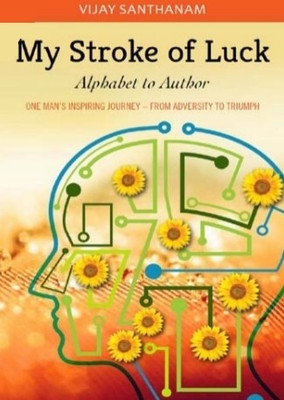
My
Stroke Of Luck is a book about Vijay Santhanam’s inspiring journey from
adversity to triumph. It is, as the book’s blurb reads, “The stimulating saga
of a man who, thanks to his never-say-die attitude, found the courage and the
determination to bounce back despite being felled by a serious, disabling
condition.”
Vijay
was afflicted with a stroke when he was 41 and working as regional marketing
director for BP (auto lubricants) – Asia-Pacific, based in Singapore. The right
side of his body was paralyzed and he could not move without help and could not
speak at all. He assiduously developed the willpower to work at regaining his
health and other faculties; according to him, when a human being is confronted
by a big crisis, often s/he summons all her/his spirit and willpower to fight back
and win. The stroke affected his left-brain; however, it left his mental
abilities intact. Simple things which we take for granted such as driving a
car, speaking to several people at once, etc. were impossible for him.
The
book is a light and easy read. Though it talks about such a serious topic,
nowhere in the book do you feel pity or sympathy for the author. Instead, what comes
across is the story of a man who refused to get bogged down by why the stroke
affected him; instead he set out to find ways and means to overcome it and
recover his health and speech as it was pre-stroke.
The
author has consciously avoided using a lot of scientific terms to explain the
stroke as it may unnecessarily confuse the readers. It is an inspiring and
motivational read as we see how Vijay takes small steps on the long journey;
how he undergoes the physical therapy, the occupational therapy and the speech
therapy.
The
detailed explanations of how he actually set out to learn the languages
(English, Hindi and Tamil) struck a chord with me. As children, we easily pick
up a new language. But to learn at the age of 44 requires great persistence
which Vijay displayed. Also, he developed his own unique learning methods to
cope with the situation – visualization of concepts worked better with him.
Reading
the book makes one realize that nothing is impossible if you put your mind to
it. Vijay had a positive mindset focused on recovery; he is also grateful that
the stroke did not affect him too severely and he was able to come out of it.
The
book provides an important insight into the functioning of the brain. The entire
left-brain/right-brain concept has been explained in a very detailed and
interesting manner. It also enlightens us on how the body has the ability to
repair itself. His analysis shows that we learn what we like. He stresses that
it is important to teach children in an interesting way; they are less likely
to remain concepts taught in a boring, purely textbook oriented manner.
Vijay
also appreciates the support and help provided by his friends and family during
his moment of crisis. He also expresses gratitude to his organization – BP –
which was there with him throughout.
Read
the book and get inspired – it will help you get a perspective on your life. I am
going with 5/5 for this book.
This review is a part of the biggest Book Review Program for Indian Bloggers. Participate now to get free books!
Sunday, June 30, 2013
Book Review: Amreekandesi – Masters Of America by Atulya Mahajan
Amreekan Desi is Atulya Mahajan’s
first book. Like many other Indians, Atulya, too, went to the US for his
Masters in 2004 and started writing a blog chronicling the lives of Indians
living abroad. The book is the culmination of that blog.
The book’s blurb reads: “Akhil
Arora, a young, dorky engineer in Delhi, can’t wait to get away from home and
prove to his folks that he can be on his own. Meanwhile in a small town in
Punjab, Jaspreet Singh, aka Jassi, is busy dreaming of a life straight out of
American Pie. As fate would have it, they end up as room-mates in Florida. But the
two boys are poles apart in their perspectives and expectations of America. While
Akhil is fiercely patriotic and hopes to come back to India in a few years,
Jassi finds his Indian identity an uncomfortable burden and looks forward to
finding an American girl with whom he can live happily ever after.
Laced with funny anecdotes and
witty insights, Amreekandesi chronicles the quintessential immigrant experience,
highlighting the clash of cultures, the search for identity, and the quest for
survival in a foreign land.”
The author’s writing style is
easy-to-read and he has painted a very vivid and true picture of life in the
US, especially for first-time Indian students. The whole experience of trying
to find an apartment, good room-mates, going shopping for Indian food, the
thrill of seeing how grand Walmart is for the very first time, the Indian
mentality of converting dollars into INR, etc. is well brought out. The author
has also elaborated quite well on the college culture – some students are there
to taste the free life, some are there to study, some experiment with drugs,
some with the opposite gender, etc.
I also quite enjoyed the part
where the students take off on short weekend trips across the US. The imagery
has been portrayed in a good manner. The relationships between the room-mates,
the boys and their prospective girlfriends, students and their professors, etc.
have been developed nicely. The part about how Akhil feels when he comes to India for a break has also been explained well - the contrasts between the US and India.
The negatives for me were firstly
that there were quite a few typos in the book; proof-reading could have
eliminated those. Secondly, it felt that the book was a little stretched and
the same topics were being repeated. Thirdly, I found the whole “Indian boys
going all crazy for American women” bit a little far-fetched, especially in the
2000s.
I am going with 3/5 for this
book; it basically offers nothing new but makes for a good, light read. Maybe people
who have absolutely no idea about American life in general and student life in
particular would enjoy reading about the experiences detailed in the book. For the
others, it is just a reaffirmation of all that they already know.
Note: I was provided a review
copy by Random House India.
Saturday, June 22, 2013
Mr. India - Evergreen Dialogues

Mr. India, which released in 1987, was a movie quite ahead of its time; what with a scientist producing a gadget which makes one disappear on wearing it. How many of us wished we owned something like that :)
In addition to some fabulous songs which the movie had (my personal favourite has to be Hawa Hawaii :)), it also had some outstanding dialogues. Some which have stayed with me are:
- Yeh football ab court jayegi. Court kyun jayegi; wahan toh koi football khelta nahi.
- Tum yeh aise ho, aise kabse ho? Bachpan se.
- Tum yeh sab kar rahe ho, kisliye kar rahe ho? Paisa (Very profound statement! Aren't all of us doing what we are for money?)
- Toh kya tum kehna chahte ho ki paise ke liye har koi chor ban jaata hain?
- Ghar; ghar ke aage balcony; balcony ke aage garden; garden ke aage samundar.
- Yeh seediyan dekh rahi hain? Yeh seediyan neeche se upar jaati hain aur yehi seediyan upar se neeche aati hain. Kamaal hain!
- Do din ke bookhe bachhe kya shor machayenge memsaab.
- Arun bhaiyya, hum ek din khaana nahi khayenge toh mar nahi jayenge.
- Chalo isi bahaane salary toh mil jayegi; kaunse rang ki hoti hain?
- Gayi bhains paani main :)
- Chaliye Arun bhaiyya ghar chaliye; ghar jaakar in kankaron main se chawal nikalne hain.
- Sir, yeh bachhe hote hi kyun hain? Sab log agar bade hi paida hue toh?
10 life lessons I learnt from my father
They say a father-daughter relationship is quite special. The father is the first man in a daughter's life and she looks upto him; every daughter idolizes her father and wishes she would eventually get married to someone like him. Every father treats his daughter like a princess and dreads the day when he has to see her get married off.

2. My father introduced me to the wonderful world of photography. I remember him carrying his huge camera along with the tripod on all our vacations and clicking innumerable pictures of us. Till today, nobody has clicked me as beautifully as my dad. To him, photographs were a way of preserving the current enjoyable moments for the future.

3. Through my father I fell in love with quotations. My father would keep these diaries into which he would note down any quotation which he came across which interested him. Occasionally, I go through his old notations; searching for him within the pages. I still follow this habit - noting down any line from a book that I am reading into a notepad.

4. A love for music is something that I picked up from my father. He was extremely fond of listening to old songs; every night, he would switch on the radio or the tape recorder and we would be listening to Muhammad Rafi/Kishore Kumar songs. He had a huge collection of cassettes. Not just listening, I also picked up a sense of appreciation - to know who the lyricist, music director, singer is.

5. My father taught me the pleasure of travelling. With him, we have traversed the icy peaks of Kashmir; taken a boat ride in Ooty; enjoyed the peaceful life in Madgaon; seen what a king lived like in Mysore. Not just outside the city, my father taught me to appreciate the many wonders the city that we live in - Mumbai - has. He was of the opinion that travelling introduces us to various cultures and expands our horizons.

6. I learnt from my father that all celebrities are approachable and friendly only if you are brave enough to approach them. He would seek out businessmen, politicians and film stars at functions and ask for their autograph also seeking to be photographed with them. There's a huge collection of him with people as varied as Bal Thackeray and Asha Bhonsale. I have inherited this mad craze for celebrities and the courage to approach them from him.

7. My father taught me the importance of spending time with the family. He would always make it a point to take us out on a weekend. We have explored places such as the Mayor's Bungalow, Aarey Milk Colony, Bandstand, Gateway of India, etc. with him. This led to the formation of a strong bond between us as a family.

8. I learnt the virtue of hard work from my father. He was known to be a disciplined worker in office. His dedication and passion towards the job shone through. He was a no-nonsense worker when it came to his tasks and was appreciated by his superiors for this quality.

9. My father taught me the importance of volunteering. As children, we would observe him stepping forth to help the not-so-privileged sections of society. He showed us the satisfaction one gets in giving back to society. To him, it came naturally and effortlessly; he never made a big deal about it.

10. I learnt to be an active member of the building complex in which we live from my father. Where most tenants would crib about the policies and facilities available, my father worked on the managing committee helping to resolve the issues and make life simpler for the residents. He never shied away from his social responsibilities. This endeared him to all the members of the building and their families.

I would like to end the blogpost by this song from Heartland; it perfectly encapsulates the feeling a father has for his daughter:
http://www.youtube.com/watch?v=ab4VRWX8y1A
I am writing ‘10 life lessons I learnt from my father’ at Parentous.com
I, too, adored my father. I have inherited quite a few traits from him including my looks, my love for reading and photography and an insatiable appetite for films and all things related.
The 10 things I learnt from my father are elaborated below:
1. My father taught me the importance of reading. It is from him that I have picked up this wonderful habit which has turned me into a voracious reader. He would always make it a point to read something daily even if he returned late from office. He believed reading not only opens up our mind but also makes us better human beings.
2. My father introduced me to the wonderful world of photography. I remember him carrying his huge camera along with the tripod on all our vacations and clicking innumerable pictures of us. Till today, nobody has clicked me as beautifully as my dad. To him, photographs were a way of preserving the current enjoyable moments for the future.
3. Through my father I fell in love with quotations. My father would keep these diaries into which he would note down any quotation which he came across which interested him. Occasionally, I go through his old notations; searching for him within the pages. I still follow this habit - noting down any line from a book that I am reading into a notepad.
4. A love for music is something that I picked up from my father. He was extremely fond of listening to old songs; every night, he would switch on the radio or the tape recorder and we would be listening to Muhammad Rafi/Kishore Kumar songs. He had a huge collection of cassettes. Not just listening, I also picked up a sense of appreciation - to know who the lyricist, music director, singer is.
5. My father taught me the pleasure of travelling. With him, we have traversed the icy peaks of Kashmir; taken a boat ride in Ooty; enjoyed the peaceful life in Madgaon; seen what a king lived like in Mysore. Not just outside the city, my father taught me to appreciate the many wonders the city that we live in - Mumbai - has. He was of the opinion that travelling introduces us to various cultures and expands our horizons.
6. I learnt from my father that all celebrities are approachable and friendly only if you are brave enough to approach them. He would seek out businessmen, politicians and film stars at functions and ask for their autograph also seeking to be photographed with them. There's a huge collection of him with people as varied as Bal Thackeray and Asha Bhonsale. I have inherited this mad craze for celebrities and the courage to approach them from him.
7. My father taught me the importance of spending time with the family. He would always make it a point to take us out on a weekend. We have explored places such as the Mayor's Bungalow, Aarey Milk Colony, Bandstand, Gateway of India, etc. with him. This led to the formation of a strong bond between us as a family.
8. I learnt the virtue of hard work from my father. He was known to be a disciplined worker in office. His dedication and passion towards the job shone through. He was a no-nonsense worker when it came to his tasks and was appreciated by his superiors for this quality.
9. My father taught me the importance of volunteering. As children, we would observe him stepping forth to help the not-so-privileged sections of society. He showed us the satisfaction one gets in giving back to society. To him, it came naturally and effortlessly; he never made a big deal about it.
10. I learnt to be an active member of the building complex in which we live from my father. Where most tenants would crib about the policies and facilities available, my father worked on the managing committee helping to resolve the issues and make life simpler for the residents. He never shied away from his social responsibilities. This endeared him to all the members of the building and their families.
I would like to end the blogpost by this song from Heartland; it perfectly encapsulates the feeling a father has for his daughter:
http://www.youtube.com/watch?v=ab4VRWX8y1A
I am writing ‘10 life lessons I learnt from my father’ at Parentous.com
Subscribe to:
Posts (Atom)